
Note: we found some more photos after we had posted this–so if you read this when we first posted, skim through and see the additional photos of the winch project.
The anchor winch on the Gyrfalcon is a major piece of work. Built in 1941, it has been lifting the anchors ever since. The anchors are no toys – each one weighs around 600 pounds. The port anchor has around 100 feet of heavy chain, followed by around 600 feet of steel cable. The starboard anchor has around 900 feet of chain. Both require a large rugged winch.

Winch (and David swabbing the deck)
Originally, the winch was powered by a 110V DC motor. This high-voltage motor developed the amount of torque required to power the winch. Approximately 20 years ago, the DC motor was replaced with hydraulic drive. Other than that, the winch is original (and now 76 years old).
We knew that the winch needed work. There was quite a bit of damage to the base, where the steel had rusted out. When we were renovating the forward stateroom, one of the large nuts on the end of a bolt that fastened the winch to the deck broke off and crashed to the floor of the stateroom , narrowly avoiding taking off the end of my nose, and other assorted body parts. We looked at the ceiling and realized that this was the second bolt to have broken off – the other having happened before we owned the boat. Since the nuts were all that held the winch to the deck, and since there was no way we could lift the anchors without the winch, we decided we needed to have the winch repaired.
When we first purchased the boat, we noticed that there was a plaque on the winch declaring that it had been built by Markey Machinery Company, Inc. in Seattle. Nancy, Historian and Internet Search Engine Extraordinaire, found that the company was still in business. Indeed, Markey has been building winches and other deck machinery since 1907. Nancy sent them an email, asking if they had any information on our winch. They responded by sending her a PDF of the original blueprints for the winch, and let us know that if we ever needed any work done on the winch, they would be able to help.

Original Proposal Letter for the winch – 1940
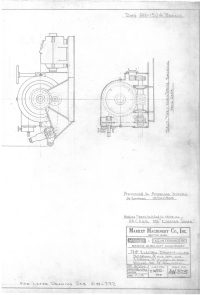
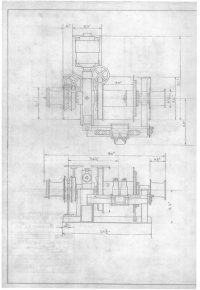
Markey had kept copies of the original plans
The renovation of the winch was on our radar, but not one of the first things we felt we needed to do. We asked Bob LeCoque, VP at Markey (and their in-house historian) to come out and give us an estimate to renovate our winch. Bob has worked at Markey for 50 years, so he did not work on the winch originally, but he thought it was a good bet that his father (who started at Markey in 1939) probably had. After examining the winch, he sent us an estimate. It was similar to the cost of replacing the winch with a new unit, which would be smaller, and probably a little more efficient, but it just didn’t seem to be in character with the rest of the boat. Nancy and I discussed it, and decided that restoration was the way to go.
Fast forward several years, while we took care of some of the more pressing repairs to the Gyrfalcon. We decided that the winter of 2017 was a good time to have the winch repaired – we were not pulling the boat this season, and the winch work could be done with the boat in the water.
Before the winch could be repaired, there was lot of coordination and preparation. Markey had a flatbed truck that would take the winch to the shop, but we needed a crane to lift the winch from the deck. We arranged with FVO at Fisherman’s Terminal to rent their crane and operator. Before lifting the crane, we took the Gyr over to LUBR (our Seattle home away from home), and had them remove all the remaining nuts, loosen the bolts as much as possible, disconnect the hydraulic lines and disconnect both anchors, so that the crane could be lifted from the deck. Two days before we were scheduled to pull the winch, the crane at FVO went down and we had to reschedule.
When the day finally arrived, we crossed the Ship Canal (FVO is right across from LUBR, and Cpt. Nancy put the Gyr right up against the dock tightly between two other boats (nice job, Nancy). FVO brought the crane out, and thus began a two-hour tug of war between the crane, the winch, and two guys from FVO. Since both of them were around my age, it looked like the winch was going to win. At first, when they applied tension to the winch the entire bow of the boat rose out of the water, but the winch stayed firmly attached. They finally bought out a strong, young guy (I swear his name was Mongo), who brought a heavy sledgehammer, and eventually the three of them convinced the winch to let go of the deck. Once free, it was put on the back of the Markey truck and taken to South Seattle for restoration. There’s a youtube video of the operation on the Gyrfalcon’s Youtube channel.
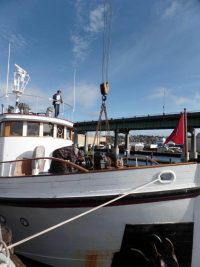
Capt. Nancy supervising the removal of the winch at FOV
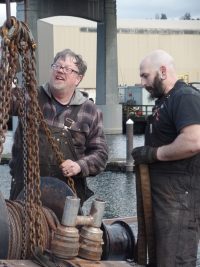
Guys from FOV working on removing the winch. On the left: Old Guy. On the right: Mongo
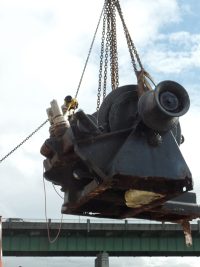
The winch clears the deck
Notice the foam insulation that was sprayed in the base, presumably in an attempt to stop leaks.
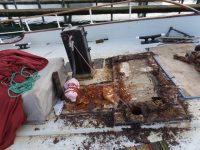
Deck after the removal of the winch
Over the years, Markey’s business has changed – they now mostly make new winches for large ocean-going tugs and other massive uses. We thought that our winch was pretty damn big – after all it weighs 3 tons – until we went to Markey and saw it in the corner of the shop – it looked like a toy there with the big boys. Unfortunately for us, although Markey was happy to work on our winch, it was always second in line behind the commercial projects, so the work, although of the highest quality, was much slower than we had hoped.
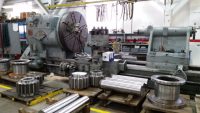
Inside Markey Machinery – Giant lathe
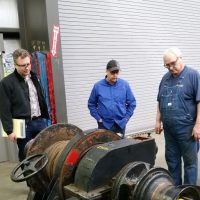
Assessing the winch at the shop
They took the winch apart – down to the individual bolts. Some of the parts were still within the original specifications (within thousandths of an inch), while others showed the signs of age and heavy use. At some point, the anchor must have gotten seriously stuck, since the shaft for the main chain was bent. When the winch was built, it had an automatic drive which moved the fairlead back and forth, so that the cable would wind evenly on the spool. This mechanism had vanished by the time we bought the boat, we decided to have it brought back to life to save the backs of crew members. Several of the parts had to be freshly manufactured.
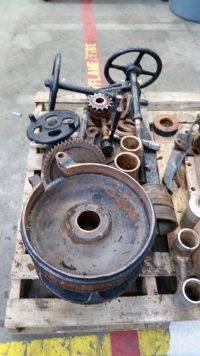
Pieces and parts of our winch
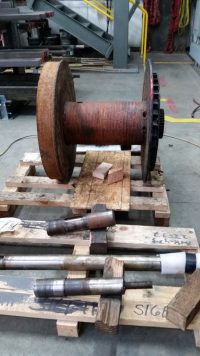
Drum and mainshaft
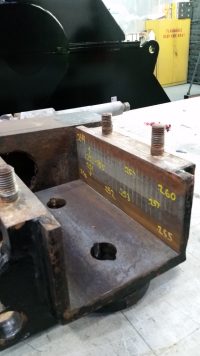
The clearances were still within a thousandth of an inch for some parts
For Bob W and other winchophiles, here are some more photos:

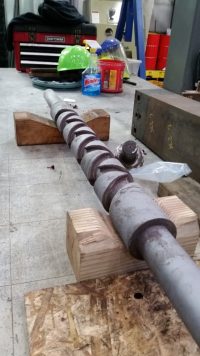

The biggest problem was the base of the winch – it was completely rusted and deteriorated. It took Markey quite a while to come up with a plan and make a new base.

Base rusted away
We made regular visits to Markey to view the progress (or lack thereof) and slowly, ever so slowly, the winch came back together. We had hope to have the new winch on the boat by late May, so that we could show it off at the Bell Street Show and then take a cruise up north in late June, but that did not happen. We took the Gyr to Bell Street without a winch (we figured the chances of needing an anchor for that short trip were minimal), and we ended up having to cancel our summer cruise, since we could not get a commitment from Markey. As you can imagine, we were not happy.
During the time that the winch was at Markey, the guys at LUBR fabricated a new wooden base out of purple heart for the winch to sit on, built a new box for the hydraulic controls (the old one was falling apart), and crafted new hydraulic hoses for the updated system.
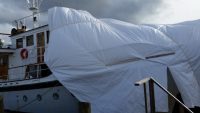
Gyrfalcon back under a tent

Kim and Joe under the tent
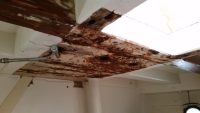
Inside Stateroom 3, where the plate holding the winch previously was attached
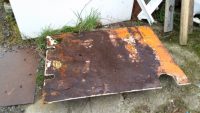
The old plate, ready for recycling
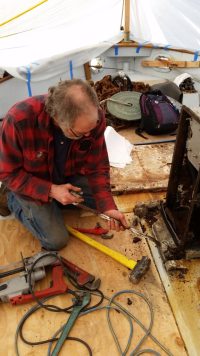
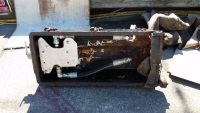
Kim dismantling the old controller box for the winch. It was attached to a concrete block base, which had cracked and had been repaired.
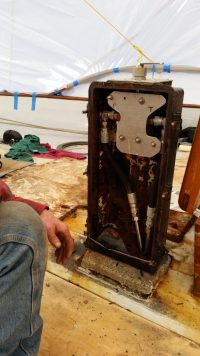
Closeup of the controller and its base
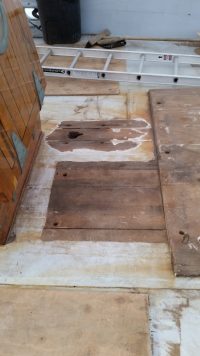
Rebuilding the deck support for the winch
A series of photos of the deck support being rebuilt
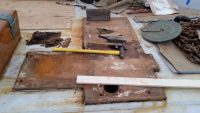
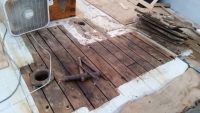

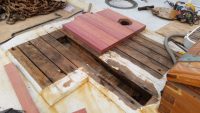
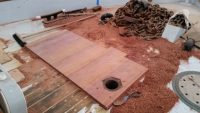


Every time we’re over at LUBR, we have the opportunity to do some projects that require tools. We boxed in some remnants of a closet in Stateroom 1, sanded/painted the area previously covered by the old winch backing plate, and varnished the inside of the hatch to Stateroom 3.
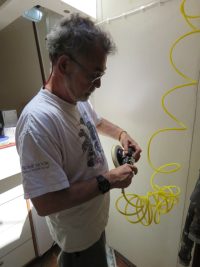
I think it plugs in this way
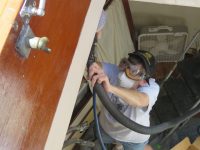
A girl and her sander
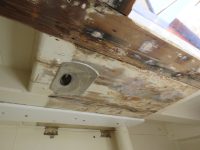
New base plate for the hydraulic lines
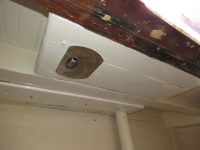
Base plate after painting

Finally, in early July, the winch was finished, and came back on the same flatbed truck. We again hired FVO to lift the winch and place it back on the deck. Click on the image below to view a video of the return of the winch.
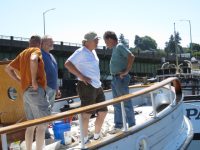
LUBR crew ready to reinstall the winch
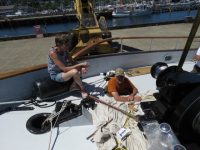
Nancy and Mike
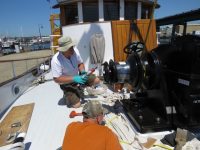
Winch is back on board
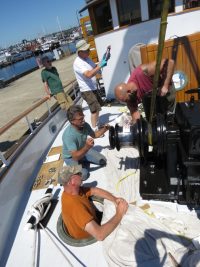
Hammering the bolts home, and caulking between the winch and the deck
It took a little while to get the holes in the winch base lined up with the holes in the deck, but eventually everything matched up, and the winch was back on the Gyrfalcon. We went back across the canal to LUBR, where they tightened down the bolts, reattached the hydraulics, put the chains for the anchors back on the winch, so that everything was fully functional.
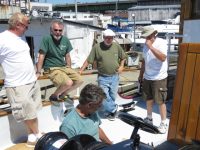
Back at LUBR, our home away from home
The “new” winch is a thing of beauty. Operations are smooth and quiet. All of the various clutches and brakes work as they were designed, and the Engineer is very happy. Nancy had a sign made to indicate the direction of the hydraulics – this was the icing on the cake.

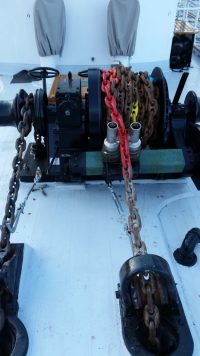
Only one quibble concerning the self-driven fairlead. When the boat was built, the drum had 30 feet of chain and 900 feet of cable, and the gearing on the fairlead is made for the predominant cable and not the chain. The anchor on the drum side now has 100 feet of chain and 600 feet of cable. The end result is that the fairlead does not move quickly enough to keep up with the chain, and we still have to crank the fairlead by hand. We like having the 100 feet of chain (extra weight on the ground) and don’t usually use more than 40 or so feet of cable. Had we realized the original design, we would probably not have rebuilt the automatic fairlead.
But it is a minor quibble. The anchor winch is beautiful, it is fully functional, and it will last long after we have left this planet.



Gearhead Bob wants much more detail on gears, clutches, fairlead drive and how did they rebuild the rotted base?
We can show you more photos, but I think you should visit Markey for more details!
Just wonderful the men who work lathes and gets their hands dirty skinned are the salt of the earth. I have worked with the same men, different accent though. a remarkable work of art, As Toad from The Wind in the Willows said, nothing beats muckin around in boats, include a beautiful small ship.