
We did not haul the Gyrfalcon last year. We felt like we needed a break from big wood projects. In the meantime, we had the anchor winch rebuilt, so it wasn’t like we were ignoring the boat’s needs. There are a couple of large wood projects left on the boat, and we decided to begin addressing them this haul out.
There’s a lot going on with the Gyrfalcon, so the story of this year’s projects will be reported in several blog entries.
First, a bit of boat anatomy. Here is a cross section through the boat where the deck meets the hull. We’ll be telling you about our bulwarks, covering board, sponson, guard, and sheerstrake in this and subsequent blogs.

Every year at the two big boat shows that we attend (Seattle Boat Show and Pacific Marine Expo), there is a lottery to win a free haul-out at Port Townsend. Nancy has a special technique that involves folding the entry/business card in a special way (which according to her makes the card more attractive to the fingers of the person drawing the winning entry. I have snorted at this “magical” approach in the past, but two years ago, she won the free haul out donated by the Port of Port Townsend. And although she does not normally win prizes, a few weeks before we pulled out, we found out that Nancy won a free haul-out from the Port Townsend Shipwrights Co-op. We met Tim Lee of the Co-op and thanked him for the haul-out, and he gave us a fantastic tour of their facility–very impressive!
We arrived in Port Townsend on the afternoon of January 1. We had spent Saturday hosting the annual Seattle Audubon Pelagic Christmas Bird Count. We dropped the birders off at Shilshole about 3:30 or 4 pm, and headed across the Sound to Port Orchard.
Night trip to Port Orchard
Being winter in the northwest, it was starting to get dark when we left Shilshole. We’ve been out to Port Orchard several times, and felt comfortable navigating at night and anchoring in a familiar place.
The next day, we headed up to Port Ludlow for New Years Eve, and then spent the next night at anchor just outside Haven Marina.
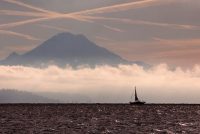
View of Mt. Rainier on our trip to Port Townsend
We were scheduled to be hauled out first thing on January 2. After a fairly uneventful trip in the 300 ton hoist (Do you remember how frightening it was the first time you bought a house – spending hours reviewing at every piece of paper you had to sign? And the next time, it was, “Oh yeah, let’s sign these things and get out of here; I have an appointment at the barber’s?” Having the boat hauled is a lot like that – progressing from terrifying to banal in just a few years.
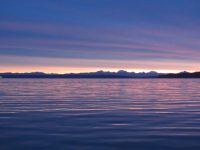
The morning was beautiful in Port Townsend
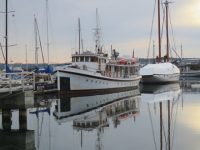
We got to the dock a bit early, so tied up in front of the Adventuress
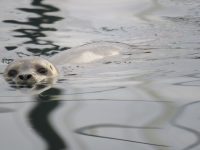
Harbor seal curious about our presence
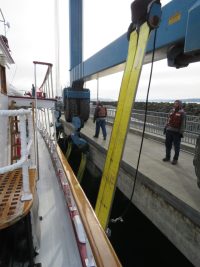
In the 300 ton hoist dock – slings in place
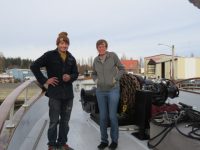 Captain Nancy and Zolly, one of our new workers from Haven
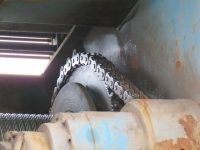
Cable and gears in the 300 ton crane
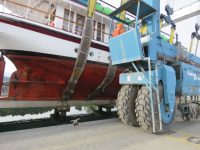
Gyrfalcon lifted in the 300 ton lift
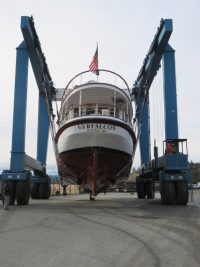
Headed toward washdown
Here’s a video if you’d like to see (in time lapse) how a boat gets hauled out using the 300 ton lift.
Two years ago, we had the portside sponson and guard replaced. This year we were going to tackle the starboard side, which, although it was not quite as bad as the port side, had issues. We also planned to address the non-functional, sonar unit that hung off the starboard side of the hull near the keel (we didn’t know the vintage, but have since found out more from Dan T–see below), and which we thought was probably responsible for the water in the associated bilges. Erica S. will know the location of the bilges–right underneath underboard.
Like all big boat projects, this one began with destruction. The old starboard guard and sponson were removed. This year we had a number of shipwrights working on the Gyrfalcon projects. Blaise is the yard foreman, and oversaw the entire project, with a very hands-on approach. Griffin was the lead shipwright – he worked on the port sponson two years ago. He was joined by several of the newer shipwrights – Zolly and Claire. Chris and Arthur joined in when needed. And when it came to really heavy lfiting, everyone in the yard came out.
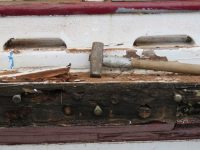
Some of the guard was removed with a few blows
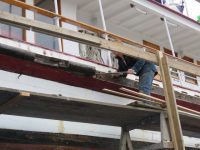
Other parts of the guard required more convincing
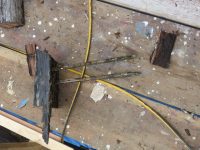
The guard was held in place with long Monel spikes
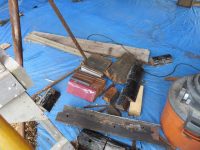
The guard is ironwood (black) while the sponson is fir (red)
The sheerstrake (the upper most plank on the hull just below the deck) was examined. As we expected (based on port side), most of the sheerstrake was rotten as well, and had to be replaced.
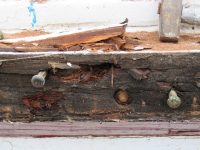
Rotten sheerstrake, after the guard and sponson have been removed
The most forward section of the sheerstrake was solid, so we were able to reuse it. The rounded stern section of the boat (fantail) has a series of boards just under the decking that extend deep into the hull, called the rim log. When we replaced the port sponson, we did not go as far aft as the rim log so we were concerned about the integrity of the remaining rim log wood. We were lucky – almost all of it was sound, with just a small bad area that will need a Dutchman (a short section of replacement wood). In addition to the sheerstrake, the plank below it also needed to be replaced for most of the length of the hull.
After the sponson/guard/sheerstrake destruction came the reconstruction. The new sponson was constructed with two layers of thick yellow cedar, which were shaped and steamed so that they would bend to conform to the shape of the hull. The planks were then clamped, glued and screwed with heavy bronze lag screws that are made especially for the Gyrfalcon (as you might guess, “especially made” does not mean inexpensive).
In order to get the angles perfect, the two shipwrights – Griffin and Zolly – built an 88-foot pattern on sawhorses that had all the various turns patterned.
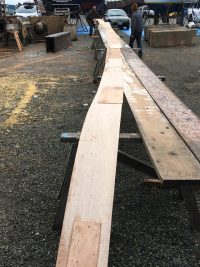
Pattern laid out for the new sponson
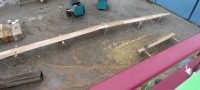
Another view of the sponson patterning
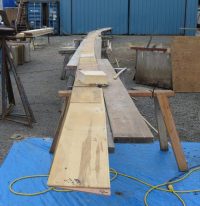
One last view of the pattern
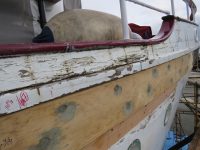
New sheerstrake in place – bolt heads sealed with concrete
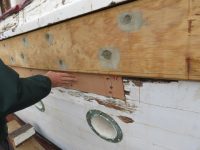
In addition to the sheerstrake, the next plank below also needed partial replacement
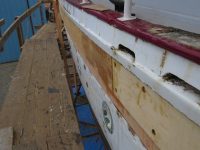
Another view of replace sheerstrake and plank
After the sheeerstrake came the sponson:
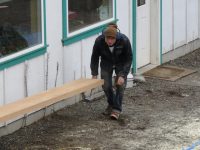
Zolly feeds a piece of rough cedar into the planer
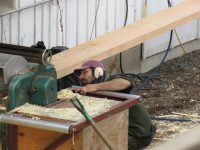
Griffin adjusting the planer (note the nifty Gyrfalcon cap)
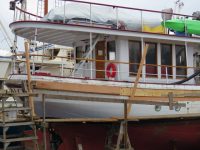
First piece of sponson on the stern of the Gyrfalcon
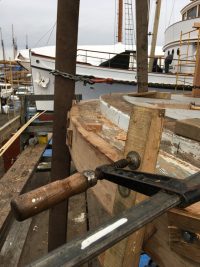
Sponson over the rim log – streamed, bent and clamped in place
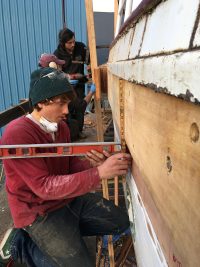
Zolly measuring the sheerstrake for the sponson, while Griffin and Chris work on the rim log
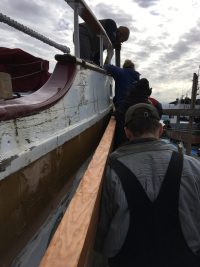
The sponson pieces are long and heavy – getting them in place is a team effort
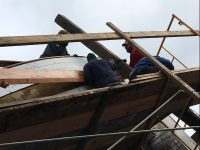
Nudging the sponson into place at the bow
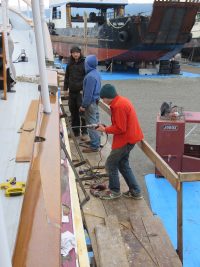
Zolly drilling lag bolt holes in the first layer of the sponson
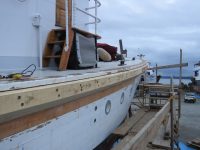
Completed sponson – view to the bow
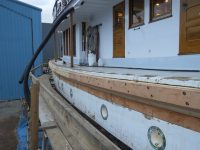
Completed sponson – midships
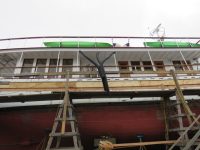
View of completed sponson from below
After the sponson was attached and faired (planed and sanded so that all the angles and turns are prefect), they fashioned the guard (the outermost section of sponson – the part that actually rubs against docks and pilings) out of purpleheart – a very hard wood.
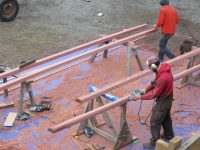
Shaping the pupleheart guard
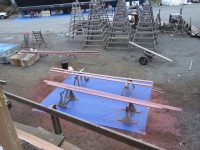
Pieces of guard ready for steaming
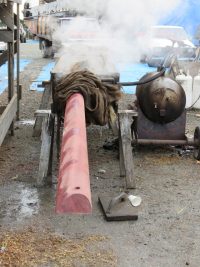
Section of guard in the steamer for bending
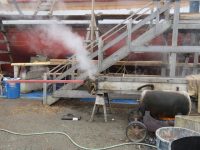
Side view of the steamer
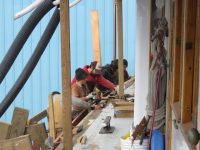
Bending a section of guard to fit the boat
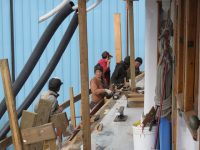
Continuing to bend the guard
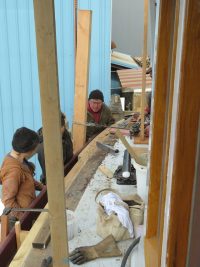
Blaise supervising the bending of the guard
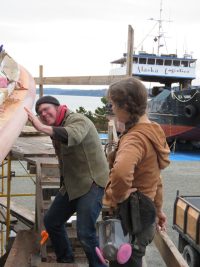
Blaise checking out Claire’s work on the finished guard
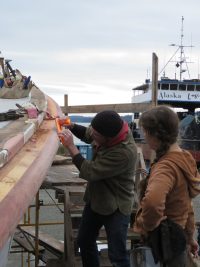
Blaise showing Claire the best way to sand and smooth the guard
And finally, we were ready for painting!
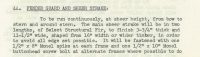
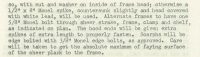
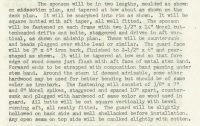
For those of you that are interested in boat construction, here are the specs for the original construction from HC Hanson in 1941.



Wonderful to see the shipwright skills ,ability, is robust and a loved work ethic. Those artisans must be kept in the game. Thanks again for the wonderful invitation to follow the life of M/V Gyrfalcon. John gates
John
Glad you are enjoying the blog. We totally agree that it is essential that the next generation of shipwrights need to be encouraged. Sometimes though, we wish that we were not supporting them in quite so robust a manner!