
Note: This is a long post about our extended time on the hard in Port Townsend from January to May 2015. We have divided it into two parts.
If you hang around wooden boats long enough, you get to learn a lot of new terminology. This year’s major new word was Delignification, defined as “removal of lignin from woody tissue (as by natural enzymatic or industrial chemical processes)”. Pretty clear, right? Lignin is “an organic substance binding the cells, fibers and vessels which constitute wood and the lignified elements of plants “ So, lignin is what holds wooden boards together, and when you delignify, the boards crumble – usually from the inside out.
So how does this happen? My understanding is that when you have a combination of certain metals, wood and salt water, there is the potential to generate a small electrical current, which causes corrosion, which forms basic alkalis, which are responsible for the actual delignification. In order to prevent this, the metal pieces of boats which are below the water line, and thus exposed to the salts in sea water, are fitted with sacrificial zinc anodes. The idea is that the zinc is more attractive to the salts than the through hulls, and the zincs corrode rather than the through-hulls. For a number of years, it was assumed that one zinc: good, many zincs: better. This is not true, and the correct amount of zinc can be measured. We are assuming that we have been overzinced in the past, and this is largely responsible for the number of delignified planks on the boat.
I’m sure that this Baby Physics Lesson has left many of you with glazed eyes: Just remember the words of Stephen Gale at Haven Boatworks, “the boards have the consistency of cat puke.”

A plank from the Gyrfalcon – rotted from the inside out – the missing portion has been delignified
All of this delignifiction menat another extended visit to Haven Boatworks in Port Townsend for some major work. We left Seattle on January 2, 2015, with our neighbors Andy and JoEllen Hathaway as crew.

Gyrfalcon leaves Settle for Port Townsend (Thanks to Jacqueline Kirchner)
When we arrived in Port Townsend, we realized that no matter how bad our problems – there is always a boat in worse condition. Here are a few shots of The Western Flyer – the boat where John Steinbeck wrote The Log of the Sea of Cortez. After many years of service, she spent the last several years on the bottom, and has been rescued for restoration.

The Western Flyer

Just a few cosmetic repairs
The Horn Timber
Another new term. The horn timber is the fore-and-aft structural member of the hull sloping up and backwards from the keel to support the counter, which is the part of the stern above the waterline that extends beyond the rudder stock to the back of the fantail.
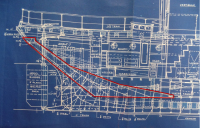
Blueprint of horntimber, outlined in red
The rudder runs through the center of the horn timber, and all the planks in the aft of the boat are tied to the horn timber. It is, to say the least, an essential part of the boat. And on the Gyrfalcon, the horn timber was delignified.
Last year, when we left Port Townsend, Stephen told us that the boat was good as long as we stayed in inland waters, but that we could get into trouble if we had strong following seas (the waves hitting the aft of the boat could play havoc with the weakened horn timber. Therefore replacing the horn timber was the Number One priority for the 2015 haul out.
The horn timber on the Gyr is massive (like everything else on the boat). The plan was to remove the old horn timber, and then fabricate a new one from several pieces of purpleheart (a very strong, dense, water-resistant wood). The plan called for replacing the current one piece horn timber with several pieces. Using several pieces meant that the planks that ended at the horn timber did not have to be removed. By using several pieces to form a huge laminate, the shipwrights would be able to maneuver the pieces in place and then bolt them together.
In preparation for taking out the old horn timber, the rudder was removed, both props and prop shafts were removed, and the sole (floor) of the lazarette had to be ripped out as well. The lazarette is the rear locker under the deck of the fantail. It is also referred to as the paint locker. Interestingly enough, the word is also used to designate a boat that is a quarantine station, or a hospital for lepers. We found lots of interesting things when the sole was cut out, but no lepers.

The shafts have been removed again – it seems like a yearly event

Forklift supporting the rudder post after removal of rudder

Rudder after removal from Gyr
The first issue was to figure out how far forward the horn timber ran. If there was enough solid horn timber forward of the rotten portion, it would be possible to scarf (overlap joints) them together. Unfortunately, the Gyrfalcon is so heavily built, it was not possible to see the forward end of the horn timber – it was covered by massive frames – without removing most of the planks at the aft of the boat, which would have been extremely expensive, even in Gyrfalcon terms.
Nancy and I had heard that HC Hanson, the naval architect who designed the Gyrfalcon, had donated all of his blueprints and plans to the Whatcom County Museum in Bellingham. It so happened that we were in Pt. Townsend when the discussions about the exact layout of the horn timber were going on, so we took the ferry back to the mainland, and headed to the Museum Archives.
The Hanson papers were not indexed – just box after box of blueprints and other papers. The Archivist was great. He kept bringing us new boxes while we searched for the one blueprint of the Gyrfalcon that would show the exact placement and dimensions of the horn timber. It took about 3 hours. We found lots of cool blueprints of the Gyrfalcon, and finally came upon the exact one that we needed. We took photographs and sent them back to Haven, where they used them to determine the extent of the project. Fortunately for everyone, there was enough good wood to allow a scarf that would be strong and permanent.

Hanson blueprint, showing horntimber from above
It took 2 shipwrights just over 4 months to take out the old horn timber, fabricate new pieces, install the new purpleheart horn timber, repair the lazarette, and put all the running gear back in the boat. Unfortunately, we could not put more than two people on the project because of the small spaces involved – anymore and they would be tripping over one another. The following pictures will, hopefully, give a sense of the enormity of the project

Stern after removal of planks to gain access to the horntimber

Nancy inspects the horntimber
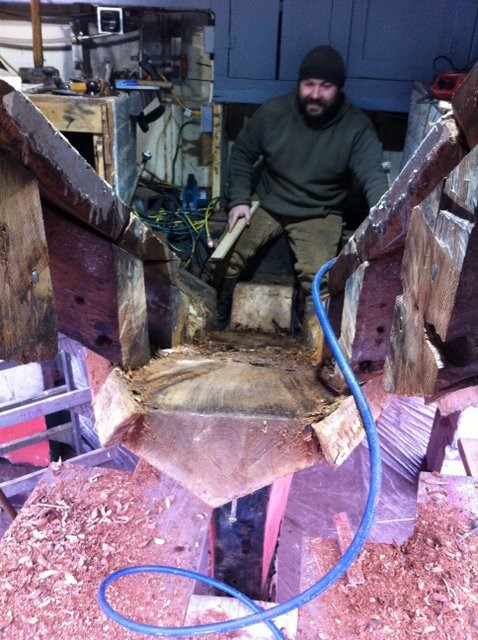
Leland in the lazarette, removing the old horntimber

Blaze and Leland discussing the project
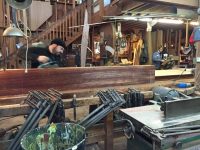
Leland working on one of the new pieces in the shop

One piece after final shaping
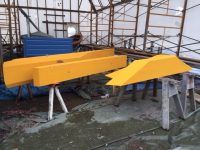
All the pieces of the new horntimber fabricated and primed ready for installation
After all of the piece were manufactured, they were carefully inserted into the lazarette using the fork lift

One of the pieces being put in place

Horntimber and struts in place in the lazarette

Sideview, midway through the project. Most of the new horntimber has been installed; planks still need to be replaced

Largest piece of new horntimber in place
To be continued……



What an illuminating & excellent article! Yes, knew that many folks like to add lots of zinc w/o calculation but did not know exactly why those figures are so important! Very cool about the blueprints. Thanks & look forward to the next installment. PW
James S. Wright 202.543.9477
I have been following your blog since I learned that the MV Gyrfalcon was originally the Raymond S. Patton. Adm. Patton was my maternal grandfather who died before I was born. I have a photograph of the Patton taken shortly after it was launched, as well as a photo of Adm. Patton. I would be glad to share copies of those photos with you should they be of interest.
It was good to be on the return trip to Seattle with you after refitting the horn timber. It was time to let Lazarus out of the Lazarette for which it was named. The Gyrfalcon lives on.